Stone carving is the practice of shaping natural stone into finished forms using cutting, chiseling, grinding, and polishing methods. Whether you are a hobbyist picking up your first chisel or an intermediate sculptor refining your craft, understanding the core techniques transforms rough rock into deliberate art.
Humans have carved stone for at least 40,000 years. The British Museum’s collection of Paleolithic carved objects confirms that early civilizations used basic percussion methods long before metal tools existed. Today, the methods range from ancient hand-tool approaches to laser-guided CNC machinery yet the foundational principles remain surprisingly unchanged.
This guide breaks down every major stone carving technique, the tools each one requires, and practical tips for choosing the right method for your project
Table of Contents
What Are the Main Types of Stone Carving Techniques?
Stone carving techniques fall into four broad categories: direct carving, indirect carving, abrasive methods, and machine-assisted methods. Each approach suits different stone types, project scales, and skill levels.
Here is a quick comparison:
| Technique Category | Primary Tools | Best For | Skill Level |
| Direct Carving | Chisels, mallets, hammers | Sculpture, architectural detail | Beginner to advanced |
| Indirect Carving | Pointing machine, calipers | Reproducing existing models | Intermediate to advanced |
| Abrasive Methods | Rasps, rifflers, sandpaper | Surface finishing, fine detail | All levels |
| Machine-Assisted | Angle grinders, CNC routers | Large-scale or precision work | Intermediate to advanced |
Direct Carving: The Traditional Hand-Tool Method
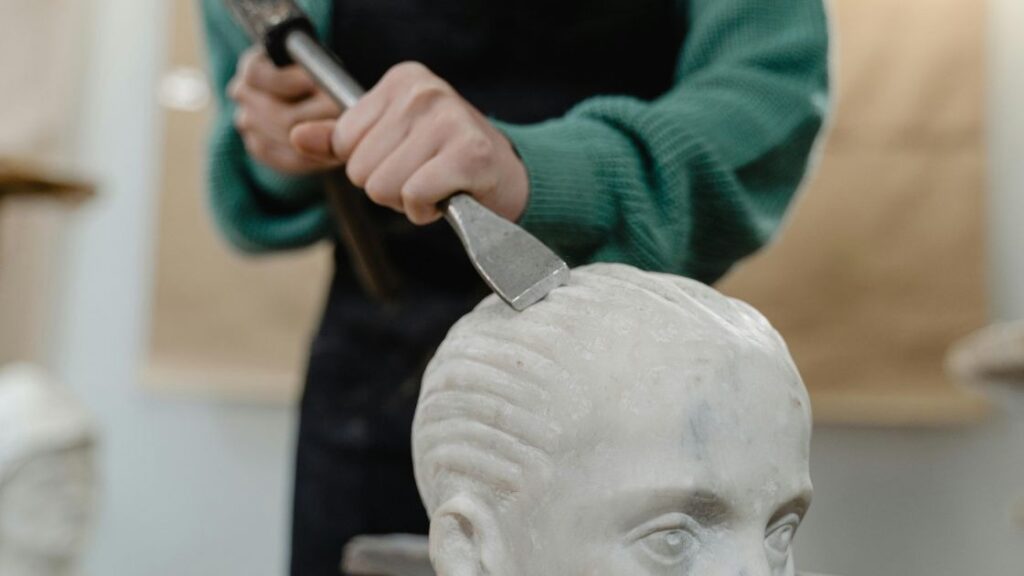
Direct carving means removing stone freehand without copying from a pre-measured model. The sculptor works intuitively, revealing the form as material is subtracted. Michelangelo famously described this as “liberating the figure imprisoned in the marble.”
This remains the most widely taught method in sculpture programs globally. According to the Sculptors Guild of America, hand-tool carving still accounts for the majority of studio-based stone sculpture produced each year.
Tools Used in Direct Carving
Every direct carving setup relies on a few essential instruments:
- Point chisel removes large amounts of rough stone quickly during the initial blocking stage
- Tooth chisel (claw chisel) refines shapes with parallel grooved cuts that leave a textured surface
- Flat chisel smooths contours and creates cleaner planes after rough shaping
- Mallet or hammer drives the chisel; wooden mallets suit softer stone while steel hammers work for granite
- Pitching tool splits away large unwanted sections along the stone’s natural grain
Step-by-Step Direct Carving Process
- Select your stone. Softer varieties like soapstone or alabaster are forgiving for beginners. Marble and limestone offer a middle ground. Granite demands experience and carbide-tipped tools.
- Rough out the form. Use a point chisel and heavy mallet to knock away large excess material. Work from all sides evenly to maintain proportions.
- Refine with a tooth chisel. Switch to a claw chisel to carve closer to your intended surface. The grooved marks help you track depth consistency.
- Shape with a flat chisel. Smooth transitional planes and define edges. At this stage, your form should be clearly recognizable.
The Smithsonian’s Archives of American Art notes that direct carving experienced a major revival during the early twentieth century when sculptors like William Zorach rejected clay-modeling intermediaries in favor of working stone directly.
Indirect Carving: Precision Through Measurement
Indirect carving uses a pre-made model usually sculpted in clay or plaster as a reference that is transferred to stone point by point.
Indirect Carving: Precision Through Measurement
Indirect carving relies on a mechanical transfer system to replicate an existing model in stone with exact proportions. This technique became the standard workshop method across European sculpture studios from the eighteenth century onward.
The key instrument is the pointing machine, a device with adjustable metal arms that measures specific points on a plaster or clay model and maps them onto the stone block. Each measured point tells the carver exactly how deep to cut at that location.
When to Choose Indirect Carving
- You need multiple identical copies of one sculpture
- Your project demands precise anatomical or architectural accuracy
- A client has approved a maquette and expects the final stone piece to match exactly
The Victoria and Albert Museum in London documents that many celebrated marble sculptures attributed to famous artists were actually transferred to stone by studio assistants using pointing machines, while the master sculptor created only the original clay model.
Indirect vs. Direct Carving: Key Differences
| Factor | Direct Carving | Indirect Carving |
| Creative freedom | High form evolves during work | Low follows a fixed model |
| Risk of error | Higher no reference to fall back on | Lower measurements guide every cut |
| Time required | Varies widely | Generally longer due to measuring |
| Ideal use case | Expressive, one-of-a-kind sculpture | Commissions, reproductions, monuments |
Abrasive Finishing Techniques
Abrasive finishing is how rough chisel marks become smooth, polished surfaces. This stage determines the final visual and tactile quality of any carved stone piece.
The process moves through progressively finer grits, similar to woodworking sanding. You begin with coarse rasps or rifflers to remove tool marks, then transition through sandpaper grits typically 80, 220, 400, 600, and finally 1200 or higher for a mirror polish.
Common Abrasive Tools
- Rasps and rifflers hand files in various curved profiles for reaching concave surfaces
- Wet-dry sandpaper silicon carbide sheets used with water to prevent dust and heat buildup
- Diamond pads synthetic abrasive pads that outlast sandpaper significantly on hard stones like granite
- Polishing compounds tin oxide or cerium oxide paste applied with felt pads for a glass-like finish
Research published by the Geological Society of America confirms that stone hardness, measured on the Mohs scale, directly determines which abrasive materials are effective. Soapstone at Mohs 1–2 polishes easily with basic sandpaper, while granite at Mohs 6–7 demands diamond abrasives.
Machine-Assisted Stone Carving Methods
Modern stone carving increasingly incorporates power tools and digital fabrication. These methods dramatically reduce production time without necessarily sacrificing artistic quality.
Angle grinders fitted with diamond-cutting discs handle rapid material removal. Pneumatic chisels powered by air compressors replicate hand-chisel motions at much higher speed. CNC routers use computer-programmed tool paths to carve complex three-dimensional forms from digital models with sub-millimeter accuracy.
According to a report by the Natural Stone Institute, CNC stone fabrication has grown substantially across architectural and memorial industries over the past decade, driven by demand for custom designs at commercial speed.
Safety Precautions for Power Tool Carving
Stone dust poses serious respiratory risks. The Occupational Safety and Health Administration classifies crystalline silica dust released when cutting granite, sandstone, or quartz as a known carcinogen. Essential safety gear includes:
- N95 or P100 respirator rated for fine particulate
- Sealed safety goggles to protect against flying chips
- Hearing protection when using grinders or pneumatic tools
- Wet cutting whenever possible to suppress airborne dust
How to Choose the Right Stone for Your Technique
Your choice of stone should match both your skill level and your intended carving method.
| Stone Type | Mohs Hardness | Best Technique | Beginner Friendly? |
| Soapstone | 1–2 | Hand carving, rasps | Yes |
| Alabaster | 2 | Hand carving, light chiseling | Yes |
| Limestone | 3–4 | Direct and indirect carving | Moderate |
| Marble | 3–5 | All hand and machine methods | Moderate |
| Granite | 6–7 | Machine-assisted, diamond tools | No |
The Stone Carving Academy recommends beginners start with soapstone or alabaster because these materials forgive hesitant chisel strikes and do not require heavy mallet force.
Conclusion
Mastering stone carving techniques means understanding which method fits your material, your tools, and your creative vision. Direct carving rewards intuition and boldness. Indirect carving delivers precision for commissions and reproductions. Abrasive finishing transforms rough surfaces into professional results. Machine-assisted approaches open doors to scale and complexity that hand tools alone cannot achieve.
Start with a soft stone and a basic chisel set. Practice the fundamental strikes point, tooth, flat until they feel instinctive. Then expand into power tools or digital methods as your confidence and project demands grow.
Have you tried any of these stone sculpting methods? Share your experience in the comments below, or pass this guide along to a fellow sculptor who is just getting started.
Frequently Asked Questions
What is the easiest stone carving technique for beginners?
Direct hand carving with soapstone is widely considered the most accessible starting point. Soapstone is soft enough to shape with basic rasps and files, which means beginners can learn form and proportion without investing in expensive chisels or power equipment.
What tools do I need to start carving stone at home?
A basic home setup requires a point chisel, a tooth chisel, a flat chisel, a wooden or rubber mallet, and a set of rasps. You should also have an N95 respirator, safety goggles, and a stable work surface. Soapstone or alabaster blocks are ideal first materials.
How long does it take to learn stone carving?
Most beginners can complete a simple soapstone sculpture within a few days of focused practice. Developing confident chisel control across harder stones like marble typically takes several months of regular work. Professional-level mastery in architectural or figurative stone carving often requires years of dedicated training.
Is stone carving dangerous?
Stone carving carries real risks if proper safety measures are ignored. Silica dust from cutting granite or sandstone can cause silicosis, a serious lung disease documented extensively by the Centers for Disease Control and Prevention. Wearing a rated respirator, using wet cutting methods, and protecting your eyes and ears significantly reduce these hazards.
Is it possible to use power tools when carving stone?
Absolutely. Angle grinders, pneumatic chisels, and CNC routers are all widely used in modern stone sculpture and fabrication. Power tools speed up material removal and enable precision that hand tools struggle to match on harder stones. However, they require stricter safety protocols and generate more dust and noise.
What is the difference between stone carving and stone sculpting?
The terms overlap significantly, but carving specifically refers to the subtractive process of removing material. Sculpting is a broader term that can include additive methods like clay modeling. When people say stone sculpting, they almost always mean carving, since stone cannot be added only taken away.