Snake plant no sunlight it sounds like a match made in heaven for that dim corner you have been staring at, but the reality is more nuanced than most plant blogs admit. As someone who has kept Dracaena trifasciata specimens in everything from south-facing windows to interior hallways with zero natural light for over a decade, I can tell you this: a snake plant will tolerate darkness better than almost any other houseplant, but “tolerate” and “thrive” are two very different words.
The short answer? Your snake plant will not die overnight without sunlight. It can coast on stored energy for several weeks. However, permanent placement in complete darkness meaning absolutely no natural or artificial light will slowly starve the plant until it collapses. The encouraging part is that the amount of light required to keep a snake plant healthy is remarkably small, and there are simple, affordable workarounds even for the darkest rooms.
This guide walks you through every angle of the topic: what actually happens inside a snake plant deprived of light, how little illumination it truly requires, which artificial options deliver real results, and the specific care adjustments that prevent the most common mistakes people make with low-light snake plants.
Table of Contents
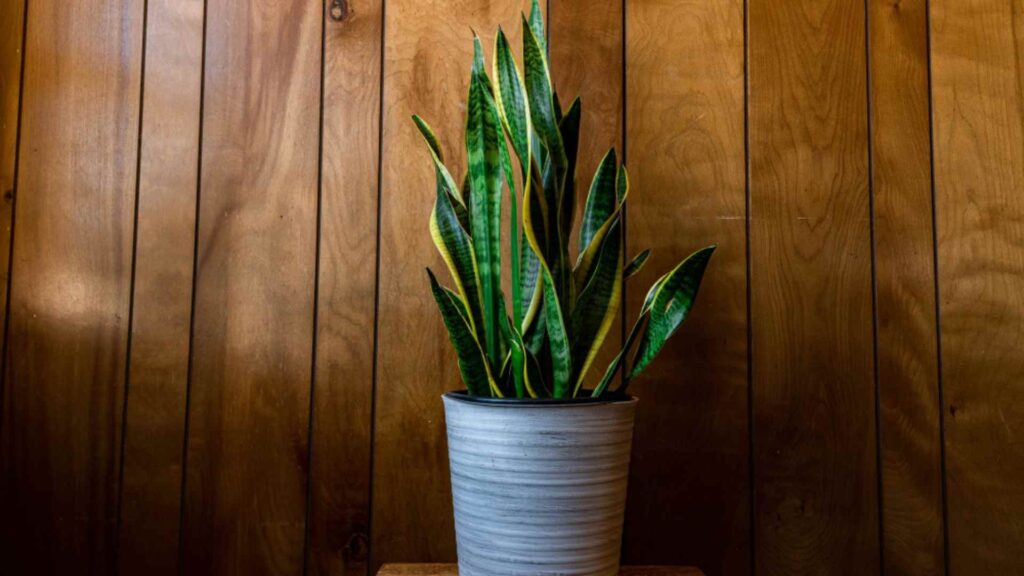
Will a Snake Plant Die Without Any Sunlight at All?
Yes, eventually. No green plant including the famously indestructible snake plant can survive forever without light. Photosynthesis is non-negotiable. It is the biochemical engine that turns light energy into glucose, and glucose is what every cell in the plant uses to grow, repair damage, and stay alive.
What sets Dracaena trifasciata apart from most houseplants is a specialized form of photosynthesis called Crassulacean Acid Metabolism (CAM). According to research documented by the American Society of Plant Biologists, CAM plants open their stomata at night instead of during the day, which dramatically reduces water loss and allows them to operate on far less light input than typical C3 plants. This metabolic efficiency is precisely why snake plants handle shade so gracefully they are wired to conserve energy in a way most tropical foliage plants simply are not.
Still, CAM photosynthesis needs some photons to work. Place a snake plant in an interior closet with the door shut, and here is the typical timeline based on my own observations and horticultural literature:
- Weeks 1–3: No visible change. The plant draws on internal carbohydrate reserves.
- Weeks 4–6: Leaves begin losing rigidity. Variegation starts fading toward uniform green.
- Weeks 7–10: Pronounced softening, yellowing, and potential fungal issues at the soil line.
- Beyond 10 weeks: Structural collapse. Recovery becomes unlikely without aggressive intervention.
The takeaway here is straightforward: a snake plant in a dark room is on borrowed time. The goal is to provide even a minimal light source so it never reaches that decline.
Exactly How Much Light Does a Snake Plant No Sunlight Require?
A snake plant needs a bare minimum of roughly 50–100 foot-candles of light to sustain itself, though 200+ foot-candles encourages noticeably healthier growth. For perspective, a well-lit office with overhead fluorescent panels typically delivers around 300–500 foot-candles at desk height.
The Missouri Botanical Garden lists Dracaena trifasciata as suitable for low-light interiors, noting that it adapts to conditions where many other ornamental species would quickly deteriorate. However, “low light” in horticultural terminology does not mean “no light.” It generally refers to spaces receiving filtered or indirect illumination for at least a few hours daily.
Here is a practical breakdown showing how different lighting scenarios influence a snake plant’s long-term health:
| Lighting Scenario | Approximate Foot-Candles | Daily Duration Needed | Expected Growth Rate | Variegation Quality | Overall Prognosis |
| Bright indirect (near a window, sheer curtain) | 400–800 fc | 5–7 hours | Moderate to vigorous | Crisp, well-defined | Excellent |
| Medium indirect (center of a well-lit room) | 150–400 fc | 5–8 hours | Slow to moderate | Good retention | Very good |
| Low indirect (far from window, north-facing exposure) | 50–150 fc | 6–10 hours | Slow | Gradually muting | Adequate |
| Artificial only (LED grow light or fluorescent) | Varies by setup | 10–14 hours | Slow to moderate | Depends on spectrum | Good with proper setup |
| Total darkness | 0 fc | 0 hours | None | Rapid fading | Terminal decline |
I measured the light levels in my own apartment using a basic lux meter app (Lux Light Meter by Elena Polyanskaya is free and reasonably accurate for casual use) and was surprised to discover that a spot I considered “dim” six feet from a west-facing window still registered around 120 foot-candles at midday. That is more than enough for a snake plant. The human eye adapts so well to low light that we often underestimate how much ambient brightness actually reaches interior spaces.
Recognizing Light Starvation Before It Becomes Fatal
The earliest sign of insufficient light in a snake plant is etiolation an abnormal stretching or leaning of leaves toward the nearest light source. Catching this symptom early gives you weeks of lead time to correct the problem before real damage sets in.
Based on guidance from Clemson University’s Home & Garden Information Center, common indicators of light deprivation in foliage houseplants include elongated internodes, reduced leaf size, and loss of color intensity. In snake plants specifically, these translate into a recognizable pattern:
- Leaning or stretching leaves the plant physically reaches toward any available light, producing thinner, weaker foliage that lacks structural rigidity. Botanists refer to this phototropic response as etiolation, and it is one of the most reliable early warnings.
- Vanishing variegation cultivars such as Dracaena trifasciata ‘Laurentii’ (the classic gold-edged variety) will gradually lose their yellow margins. The plant reallocates resources toward producing more chlorophyll to capture whatever scarce light exists, so leaves trend toward solid dark green.
- Mushy or floppy leaf bases healthy snake plant leaves are stiff enough to stand upright without support. When the plant cannot generate enough energy to maintain cell turgor pressure, the lower portions of leaves soften first.
- Persistently damp soil this one is often overlooked. A light-starved snake plant transpires far less water because its stomata remain closed more frequently. The soil stays moist for much longer, creating ideal conditions for Pythium and Fusarium root rot pathogens.
- Complete growth halt if your snake plant has not produced a single new leaf in six months or more (during the active growing season of spring through early fall), inadequate light is the most probable culprit.
Noticing even one or two of these symptoms warrants action. The fix does not have to be dramatic sometimes shifting the pot three feet closer to a window or adding a small desk lamp with a daylight-spectrum bulb is all it takes.
Growing a Snake Plant Under Artificial Light: What Actually Works
A snake plant can absolutely grow under artificial light as its sole energy source, provided you choose the correct bulb type and run it long enough each day. This makes snake plants one of the best indoor plants for windowless rooms, cubicles, and basement apartments.
Research from the University of Minnesota Extension explains that artificial light sources vary dramatically in their photosynthetically active radiation (PAR) output the specific wavelengths between 400 and 700 nanometers that plants actually use. A bulb might appear bright to your eyes yet deliver almost nothing in the wavelengths chlorophyll absorbs.
Which Bulbs Deliver Results and Which Waste Your Money
Not all artificial light is created equal for plant growth. Here is an honest comparison based on both published horticultural research and my personal experiments running different setups in a windowless home office:
| Light Source | Spectrum Profile | PAR Output | Distance from Plant | Daily Run Time | Snake Plant Effectiveness |
| Full-spectrum LED grow light (e.g., Sansi, GE Grow) | Balanced red + blue + white | High | 6–12 inches (desk clip) / 2–3 feet (panel) | 10–14 hours | Excellent closest artificial substitute for sunlight |
| T5 or T8 cool white fluorescent tube | Blue-heavy, moderate red | Moderate | 6–18 inches | 12–14 hours | Good reliable and inexpensive for shelving setups |
| Daylight LED household bulb (5000K–6500K) | Broad white, moderate blue | Low to moderate | 12–24 inches | 12–16 hours | Acceptable a solid budget-friendly option |
| Warm white LED (2700K–3000K) | Yellow-heavy, minimal blue | Low | Any distance | Any duration | Poor insufficient blue spectrum for sustained photosynthesis |
| Incandescent bulb | Red-heavy, excessive heat | Very low PAR per watt | Must be kept distant due to heat | Not practical | Not recommended inefficient and risky |
The single most cost-effective option for most people is a full-spectrum LED grow bulb that screws into a standard E26 socket. These typically cost between eight and twenty dollars, consume 10–20 watts of electricity, and last upward of 25,000 hours. Pair one with a basic clamp lamp or desk fixture, set it on a timer for 12 hours daily, and your snake plant has everything it needs to maintain healthy foliage indefinitely no window required.
Positioning Your Grow Light Correctly
Distance matters more than most people realize. Light intensity follows the inverse square law: doubling the distance between bulb and leaf cuts the received light to roughly one-quarter. A grow bulb sitting four feet above a snake plant delivers a fraction of the energy it would at twelve inches.
For compact clip-on or gooseneck LED grow lights, position the bulb 6 to 12 inches directly above or beside the tallest leaf. For larger panel-style fixtures, 18 to 30 inches is a practical range. If leaves begin showing pale spots or slight browning at the tips, the light is too close or too intense back it off a few inches and monitor for a week.
Smart Placement Strategies for Snake Plants in Low-Light and Dark Spaces
Even without investing in grow lights, a handful of low-effort placement tricks can meaningfully increase the ambient light your snake plant receives.
Elevate the Plant Above Floor Level
Light drops off steeply as you move away from a window and toward the floor. Interior designers and plant stylists know this intuitively placing a snake plant on a shelf, console table, or tall plant stand at waist height or above captures significantly more reflected light bouncing off ceilings and upper walls. In a test I ran in my own living room using a lux meter, a spot on the floor eight feet from a window measured roughly 40 foot-candles, while the same horizontal distance on a four-foot-high shelf registered closer to 90 foot-candles. That difference alone can determine whether a snake plant merely survives or actually grows.
Use Reflective Surfaces Strategically
A white-painted wall behind your snake plant acts as a passive reflector, bouncing ambient light back toward the foliage. A small decorative mirror placed opposite the plant’s primary light source amplifies the effect further. These are zero-cost modifications that interior plantscaping professionals routinely employ in commercial installations hotel lobbies, restaurant atriums, and corporate offices where plants must look healthy in architecturally challenging lighting.
Rotate the Pot Every Two to Three Weeks
Snake plants in dim environments develop a noticeable lean toward whatever faint light exists. Giving the pot a quarter-turn on a regular schedule ensures all sides of the plant receive relatively even exposure, preventing the lopsided silhouette that screams “this plant is desperate for light.”
Consider a Seasonal Light Rotation
If you have one brighter spot in your home and multiple snake plants in darker locations, rotating them through the bright position on a monthly cycle lets each plant periodically recharge its energy reserves. Think of it as a vacation for your plant two to three weeks near a window every couple of months can offset a lot of time spent in a dim hallway.
Adjusting Your Care Routine for a Snake Plant in Low or No Sunlight
The number one killer of snake plants in dark rooms is overwatering not the darkness itself. When a snake plant receives minimal light, its metabolic rate drops substantially. It uses less water, grows less tissue, and requires far fewer nutrients. Your care routine must scale down accordingly, or you risk root rot, the most common and most lethal problem for this species.
Watering: Less Is Almost Always More
In bright conditions, a snake plant might need water every 10 to 14 days during summer. In a low-light setting, stretch that interval to every three to five weeks in warm months and every five to eight weeks in winter. The Royal Horticultural Society emphasizes that Sansevieria species store water in their thick, succulent leaves and are far more tolerant of drought than excess moisture.
The most reliable test is the finger method: push your index finger two full inches into the soil. If you detect even slight dampness, do not water. Wait another five to seven days and check again. In a dark room, erring on the side of too dry is always safer than too wet.
Soil Mix: Drainage Is Non-Negotiable
Standard all-purpose potting soil retains too much moisture for a snake plant in low light. Switch to a cactus and succulent blend, or create your own by mixing regular potting soil with an equal volume of perlite or coarse sand. The goal is a medium that releases water quickly so the root zone never stays soggy for extended periods.
A well-draining pot with at least one drainage hole is equally critical. Decorative cache pots without holes are fine as outer sleeves, but always grow the plant in an inner nursery pot that allows excess water to escape freely.
Fertilizer: Scale Down Dramatically
A snake plant in a dark room is barely growing, so pumping nutrients into the soil achieves nothing except salt accumulation that can burn roots. Apply a half-strength balanced liquid fertilizer (such as a 10-10-10 or 20-20-20 diluted to 50%) no more than twice per year once in mid-spring and once in early summer. Skip fertilizing entirely during fall and winter.
Temperature and Airflow
Dracaena trifasciata originates from the dry, warm savannas of West Africa, per the Royal Botanic Gardens, Kew plant profile. It thrives between 60°F and 85°F (16°C to 29°C) and dislikes sudden temperature swings. In a dark interior room, keep the plant away from air conditioning vents in summer and cold drafts near exterior doors in winter. Stressed plants in low light have fewer reserves to recover from thermal shock.
Humidity rarely causes issues. Snake plants evolved in arid conditions and handle the dry air typical of heated and air-conditioned interiors without complaint.
Conclusion: Your Snake Plant Demands Very Little But Not Nothing
Let’s bring it all together. A snake plant with no sunlight is not a hopeless situation, but it is a situation that requires honest expectations and a few deliberate adjustments. Complete permanent darkness will eventually kill even the hardiest Dracaena trifasciata, but the threshold of light needed to sustain one is genuinely low lower than most people expect.
A north-facing window several feet away, a ten-dollar LED grow bulb on a twelve-hour timer, or even the overhead fluorescent panels in a typical office can provide more than enough energy to keep your snake plant standing tall with attractive foliage for years. Combine that modest light with infrequent watering, fast-draining soil, and minimal fertilizer, and you have a care formula that is almost impossible to mess up.
If you are choosing a houseplant specifically for a challenging, dimly lit space, snake plants remain one of the most forgiving options available. Just remember that “low light tolerant” is not a synonym for “no light required.”
Have you managed to keep a snake plant healthy in an unusually dark room? Drop a comment below with your setup details your firsthand experience could save another reader’s struggling plant.
Can a snake plant live permanently in a room with no windows?
Only if you supply consistent artificial light. A full-spectrum LED grow bulb running 10 to 14 hours daily provides enough photosynthetically active radiation to keep a snake plant healthy in a completely windowless space. Without any light source, the plant will deplete its stored energy within roughly four to eight weeks and begin a slow, visible decline.
How many weeks can a snake plant survive in total darkness?
A well-established snake plant with healthy energy reserves can typically endure complete darkness for about four to six weeks before you notice the first warning signs usually softening leaves and fading color. Beyond eight to ten weeks, the damage often becomes severe enough that recovery is difficult even after returning the plant to adequate light.
What is the single best light for a snake plant in a dark room?
A full-spectrum LED grow light offers the best combination of effectiveness, energy efficiency, and affordability. Look for a bulb rated between 5000K and 6500K color temperature with a PAR output designed for plant growth. Position it 6 to 12 inches above the plant and run it on a timer for 12 to 14 hours per day to approximate natural daylight conditions.
Does a snake plant still clean the air when it gets very little light?
The well-knownNASA Clean Air Study demonstrated that Sansevieria trifasciata can remove volatile organic compounds such as formaldehyde and benzene from indoor air. However, this filtration is driven by photosynthesis and microbial activity in the root zone both of which slow significantly under low light. A snake plant in a dim room still contributes to air quality, but at a meaningfully reduced rate compared to one receiving bright, indirect light.
Should I periodically move my snake plant to a bright spot to recharge it?
Yes, this is an excellent low-cost strategy. Placing your snake plant near a bright window for two to three weeks every couple of months allows it to replenish carbohydrate reserves and push out new growth. When transitioning it back to a darker area, avoid sudden exposure to intense direct afternoon sunlight, which can scorch leaves that have acclimated to dim conditions. A gradual transition over two to three days prevents leaf burn.
Which houseplants tolerate low light even better than snake plants?
Very few species match the snake plant’s combination of low-light tolerance and low maintenance. However, pothos (Epipremnum aureum), ZZ plant (Zamioculcas zamiifolia), and cast iron plant (Aspidistra elatior) are comparable performers in dim conditions. Among these, the ZZ plant arguably edges out the snake plant in extreme shade tolerance, as it also employs a highly efficient underground rhizome storage system, according to plant profiles from theNorth Carolina State University Extension.