The most effective dehumidifying plants for bedroom are the snake plant, peace lily, Boston fern, English ivy, and tillandsia (air plant). Waking up to damp pillowcases, condensation streaking your windows, and a stale, heavy smell hanging in the air these are telltale signs that your bedroom humidity has crept out of control. Before you invest in a bulky, noisy electric dehumidifier, consider a greener solution sitting right at your local nursery.
Short answer: These species draw water vapor from the air through a biological mechanism called foliar uptake, where moisture enters through microscopic leaf pores (stomata) and travels into the plant’s internal water system. Pairing two to four of these species in your sleeping space can help nudge indoor moisture toward the30–50% relative humidity range the U.S. Environmental Protection Agency (EPA) recommends.
This guide walks you through the full science of how plants absorb humidity, ranks the 10 best bedroom-safe options with detailed care instructions, and shares placement strategies that maximize their moisture-reducing power.
Table of Contents
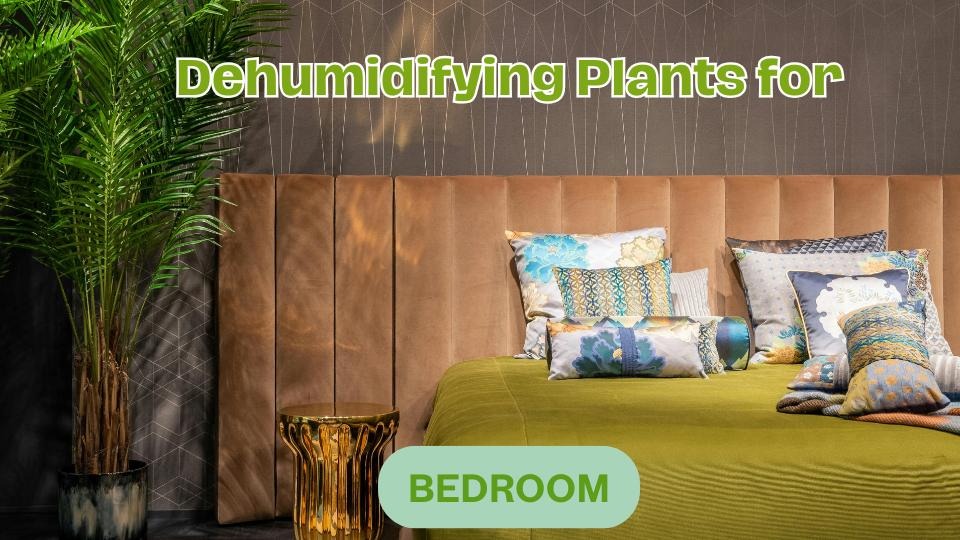
How Does Dehumidifying Plants for Bedroom Affect Sleep and Health?
High bedroom humidity disrupts sleep architecture, promotes allergens, and increases your risk of respiratory illness. Keeping moisture balanced in your sleeping space is one of the simplest upgrades you can make for your wellbeing.
According to Sleep Foundation research, elevated humidity reduces the time you spend in both slow-wave NREM and REM sleep two stages essential for tissue repair, immune function, and memory consolidation. Put simply, damp air means shallower, more fragmented rest.
The problems extend well beyond poor sleep. The EPA’s mold prevention resource states that indoor relative humidity above 60% creates favorable conditions for mold spores, dust mites, and cockroaches all of which are documented triggers for asthma, allergies, and chronic sinus congestion. A 2025 laboratory study published on ScienceDirect reinforced this, finding that sleep quality in older adults declined significantly at both 40% and 80% relative humidity compared to a 60% baseline.
Meanwhile, a peer-reviewed observational study from the University of Pennsylvania found dose-dependent relationships between bedroom environmental conditions (including humidity) and reduced sleep efficiency. Higher exposure levels consistently correlated with more nighttime wakefulness and poorer rest.
The bottom line: moisture in your bedroom is not just an annoyance it is a measurable health variable. Controlling it should be as much a priority as adjusting your thermostat or choosing the right pillow.
The Science: How Do Houseplants Pull Moisture Out of the Air?
Certain houseplants function as biological dehumidifiers by absorbing atmospheric water vapor directly through their foliage a mechanism plant scientists call foliar uptake.
Here is how it works. Tiny openings on the surface of leaves, known as stomata, open and close to regulate gas exchange. When they open, they also allow water vapor from the surrounding air to enter the leaf tissue. This moisture then moves downward through the plant’s vascular system (xylem) to the roots, where it fuels metabolic processes and growth. As Gardening Know How explains, some species are particularly efficient at this, harvesting the vast majority of their hydration from fog, dew, and ambient humidity instead of soil water.
A special category of plants epiphytes like tillandsia takes this even further. These “air plants” grow entirely without soil and depend completely on atmospheric moisture captured through specialized leaf structures called trichomes.
An important reality check: Houseplants offer meaningful supplemental humidity control, but they cannot match the raw extraction capacity of a mechanical dehumidifier. The well-known 1989 NASA Clean Air Study demonstrated impressive pollutant removal and moisture regulation in sealed test chambers. However, a 2019 meta-analysis cited by the American Lung Association concluded that replicating those lab-scale results in a real home with natural ventilation would require an impractically large number of plants. The practical takeaway is this: a curated group of humidity-absorbing species in your bedroom provides a genuine, measurable benefit especially when combined with basic ventilation habits but should not be treated as a standalone fix for severe dampness.
The 10 Best Dehumidifying Plants for Your Bedroom (Ranked)
The following table provides an at-a-glance comparison. Detailed care profiles for each plant follow below.
| # | Plant | Light Requirements | Maintenance | Safe for Pets? | Ideal Bedroom Placement |
| 1 | Snake Plant | Low to bright indirect | Minimal | No | Nightstand or dim corner |
| 2 | Peace Lily | Low to medium indirect | Low | No | Dresser near filtered light |
| 3 | English Ivy | Bright indirect | Moderate | No | Hanging planter or high shelf |
| 4 | Boston Fern | Filtered indirect | Moderate | Yes | Hanging basket or plant stand |
| 5 | Tillandsia (Air Plant) | Bright indirect | Minimal | Yes | Windowsill or wall mount |
| 6 | Spider Plant | Bright indirect | Minimal | Yes | Bookshelf or hanging pot |
| 7 | Reed Palm | Bright indirect | Low | Yes | Floor pot near window |
| 8 | Orchid | Bright indirect | Moderate | Yes | Sunny windowsill |
| 9 | Pothos | Low to medium | Minimal | No | Trailing shelf or macramé hanger |
| 10 | Aloe Vera | Bright direct/indirect | Low | No | Sunny windowsill |
1. Snake Plant (Sansevieria trifasciata)
What makes the snake plant uniquely valuable for a bedroom is its reliance on CAM (Crassulacean Acid Metabolism) photosynthesis a metabolic pathway that keeps stomata open at night rather than during the day. This means the plant is actively drawing in water vapor and releasing fresh oxygen precisely when you are asleep.
Everest’s guide to condensation-reducing plants highlights the snake plant as one of the top performers for overnight window condensation and notes its capacity to break down chemicals like trichloroethylene a compound present in many household cleaning products.
Practical care: Water once every two to three weeks, allowing the soil to go fully dry between sessions. Snake plants tolerate near-darkness and bright indirect light equally well. Avoid overwatering soggy soil is the fastest way to kill this otherwise indestructible plant. Note that it is mildly toxic to cats and dogs, so elevate it or use a closed plant stand if pets share your room.
2. Peace Lily (Spathiphyllum)
The peace lily pairs broad, glossy foliage with high foliar uptake efficiency, creating a generous surface area that draws moisture from bedroom air continuously. According to Air & Energy of NWFL, this species works double duty by filtering harmful airborne pollutants such as ammonia, benzene, and formaldehyde from indoor environments all at once.
Practical care: Position on a dresser or shelf with soft, indirect light. The plant communicates its watering needs clearly leaves droop noticeably when thirsty and rebound quickly once hydrated. Wipe leaves every couple of weeks with a damp cloth to prevent dust from blocking stomata. Peace lilies contain calcium oxalate, which is toxic to pets if chewed, so place them out of reach or opt for a pet-friendly alternative.
3. English Ivy (Hedera helix)
This evergreen vine does double duty: it absorbs airborne moisture and filters mold spores from the surrounding environment. Balcony Garden Web recommends growing English ivy in hanging planters positioned close to ceiling height, taking advantage of the fact that warm, humid air naturally rises and concentrates at the top of a room.
Practical care: Provide bright, indirect light and keep soil evenly moist without waterlogging. Trim runners periodically to maintain shape. English ivy is classified as invasive outdoors in many climates, so restrict it to indoor cultivation. It is toxic to cats and dogs a ceiling-mounted or wall-mounted planter keeps it safely out of reach.
4. Boston Fern (Nephrolepis exaltata)
Among common houseplants, the Boston fern possesses one of the highest transpiration rates it constantly cycles water between its lush, arching fronds and the air around it. The 1989 NASA Clean Air Study singled it out as a top performer for removing volatile organic compounds such as formaldehyde, xylene, and toluene.
Practical care: This fern thrives in filtered, indirect light and evenly moist soil, with a preferred temperature range of 65–75°F (18–24°C). A hanging basket beside a north-facing bedroom window is ideal. Boston ferns are slightly more demanding than snake plants their frond tips brown and crisp if surrounding humidity drops too low. Combat this with occasional misting or a pebble tray filled with water beneath the pot. The major advantage for pet owners: Boston ferns are completely non-toxic to cats and dogs.
5. Tillandsia (Air Plant)
No other bedroom plant absorbs moisture quite like tillandsia. As a true epiphyte, it grows without any soil at all, pulling 100% of its water and nutrient needs directly from the atmosphere through specialized trichome structures on its leaves. Gardening Know How describes tillandsia as among the most efficient natural dehumidifiers available.
Practical care: Display in a glass terrarium, on a piece of driftwood, or simply on a windowsill. In a humid bedroom, air plants may not need watering beyond what they pull from the room itself. In drier conditions, soak them for 20 minutes once a week and shake off excess water. They are fully pet-safe and take up virtually no space.
6. Spider Plant (Chlorophytum comosum)
The spider plant combines strong moisture absorption with prolific reproduction it sends out long runners tipped with “baby” plantlets that you can snip and pot to expand your collection at no cost. Balcony Garden Web notes that spider plants also contribute meaningfully to formaldehyde removal from indoor air.
Practical care: Bright indirect light is optimal, though spider plants adapt well to dimmer bedrooms. Water when the top inch of soil feels dry, typically once a week. Non-toxic to pets, inexpensive, and nearly impossible to kill this is one of the strongest beginner-friendly options on the list.
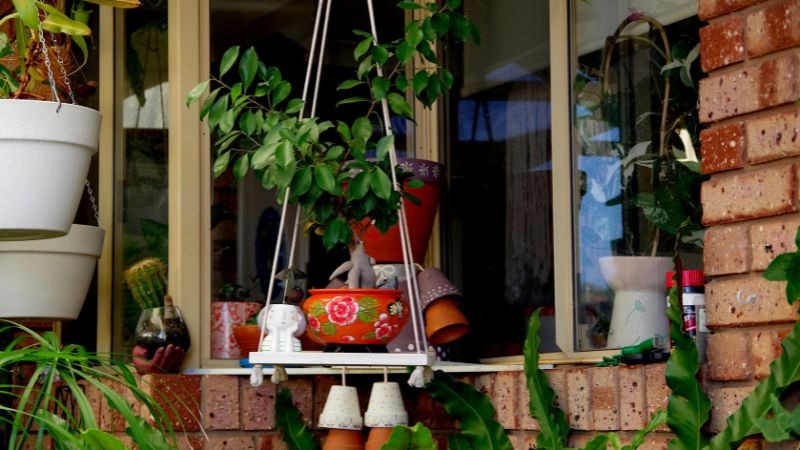
7. Reed Palm (Chamaedorea seifrizii)
Often sold under the name bamboo palm, this compact tropical species brings one of the highest transpiration rates of any palm suitable for indoor growing. Air & Energy of NWFL highlights its effectiveness at absorbing humidity while simultaneously filtering benzene and formaldehyde.
Practical care: Place in a floor pot near a bedroom window with bright, indirect light. Keep soil consistently moist but well-drained. Reed palms reach three to five feet at maturity indoors and are non-toxic to pets, making them the safest large-format dehumidifier for a family bedroom.
8. Orchid (Phalaenopsis)
Phalaenopsis orchids absorb considerable moisture through their exposed aerial roots and thick, waxy leaf surfaces. According to Mira Showers’ guide on moisture-absorbing plants, orchids flourish in humid indoor spaces and naturally pull water vapor from the surrounding air.
Practical care: Set on a bright windowsill with indirect light. Unlike most bedroom plants, orchids prefer their potting bark to dry slightly between waterings typically every 7 to 10 days. They are non-toxic to pets and add striking visual elegance to any bedroom.
9. Pothos (Epipremnum aureum)
Commonly called devil’s ivy, pothos is a vigorous trailing vine with thick, heart-shaped leaves that harvest ambient moisture efficiently. It adapts to almost any light level from a dim bedside table to a bright shelf and grows rapidly with little intervention.
Practical care: Water when the top layer of soil dries out, roughly every one to two weeks. Hang it in a macramé planter or let it trail along a high bookshelf for both aesthetic appeal and elevated moisture capture. Pothos is toxic to cats and dogs if eaten, so keep it out of pet reach.
10. Aloe Vera (Aloe barbadensis miller)
As a succulent evolved in arid desert climates, aloe vera is hardwired to absorb and store water rather than lose it. When placed in a humid bedroom, it draws excess vapor from the air and locks it inside its thick, gel-filled leaves, acting as a slow, passive dehumidifier.
Practical care: Provide several hours of bright, direct or indirect sunlight daily. Water sparingly every two to three weeks using a pot with excellent drainage. Aloe is mildly toxic to pets, so place it on a high windowsill beyond the reach of curious animals.
Strategic Placement: Where to Position Bedroom Plants for Maximum Moisture Removal
Buying the right plants is only half the equation. Where you place them determines how much humidity they actually remove. Follow these five evidence-based positioning principles:
- Set the strongest absorbers near your room’s primary moisture source. If your bedroom shares a wall with a bathroom or has a window prone to condensation, position a peace lily or Boston fern within a few feet of that spot.
- Elevate trailing species toward the ceiling. Because warm, humid air rises, hanging English ivy or spider plants from ceiling hooks or high shelves intercepts moisture where it concentrates most.
- Group multiple species into a cluster. Placing two or three humidity-absorbing plants together generates a concentrated microclimate that amplifies each plant’s individual dehumidifying effect.
- Keep airflow unrestricted. Stomata function best when air circulates freely across leaf surfaces. Avoid jamming pots tightly against walls, inside closed cabinets, or in dead-air corners.
- Match each species to its correct light zone. A snake plant can sit in a dim corner; an orchid belongs on a bright windowsill. Mismatched lighting stresses plants and reduces their moisture uptake capacity.
How many plants do you actually need? B.C. Wolverton, the principal investigator behind NASA’s indoor air quality research, recommended at least two well-sized plants per 100 square feet. A separate study funded by Hort Innovation and reported by Gardening Know How found that a single houseplant in an average-sized room improved measured air quality by about 25%, while two plants pushed that improvement to roughly 75%. For a standard bedroom of 120–150 square feet, starting with two to four strategically placed plants is a practical, effective baseline.
Common Mistakes That Undermine Your Bedroom Plants’ Performance
Even seasoned plant owners make errors that sabotage dehumidification. Avoid these four pitfalls:
Drowning the soil. Overwatering is the most common plant-care mistake and the most counterproductive one for humidity control. Waterlogged soil breeds mold on the surface, and as the American Lung Association warns, airborne mold spores from overwatered houseplants can aggravate allergies and asthma the exact problems you are trying to solve. Let the top inch of soil dry between waterings for most species.
Ignoring light compatibility. A Boston fern placed in harsh afternoon sun will develop brown, crispy fronds and cease absorbing moisture effectively. A snake plant left in total darkness will stretch, weaken, and eventually die. Always audit the real light conditions in your bedroom before selecting a species.
Letting dust accumulate on leaves. A thin layer of household dust can seal off stomata, dramatically reducing the plant’s ability to pull water vapor from the air. Gently wiping each leaf with a damp cloth every two to three weeks solves this instantly.
Using pots without drainage holes. Standing water beneath roots triggers root rot and creates a humid, stagnant micro-environment that fosters the very mold and mildew you are trying to eliminate. Always choose pots with bottom drainage, and empty saucers promptly after watering.
Conclusion: Breathe Easier and Sleep Deeper With the Right Bedroom Plants
Moisture-absorbing houseplants provide a quiet, energy-free, and visually rewarding method for managing excess bedroom humidity the room where you spend roughly one-third of your life. Whether you choose the nighttime oxygen-producing snake plant, the lush fronds of a Boston fern, or the soilless simplicity of a tillandsia air plant, each species on this list reduces airborne moisture through proven biological mechanisms.
Here is the action plan: pick two to four plants that suit your bedroom’s light profile and your personal care commitment. Position them near condensation zones and at varying heights. Maintain clean leaves, proper drainage, and appropriate watering schedules. Within a few weeks, you should notice tangible improvements in how your bedroom air feels, smells, and supports your sleep.
Remember, these plants supplement not replace good ventilation and, in severe cases, a mechanical dehumidifier. But for the mild-to-moderate dampness most bedrooms experience, the right greenery makes a surprisingly noticeable difference.
So, which moisture-absorbing plant is earning a spot on your nightstand tonight?Drop your pick in the comments, or share this guide with someone struggling through sticky, restless nights. Healthier air starts with a single pot of soil or, in tillandsia’s case, no soil at all.
Frequently Asked Questions (FAQ Schema Ready)
Do plants actually reduce bedroom humidity, or is it a myth?
It is not a myth, but it requires realistic expectations. Plants absorb water vapor through their leaves via foliar uptake, which genuinely lowers ambient moisture in a room. The 1989 NASA Clean Air Study demonstrated measurable humidity and pollutant absorption in sealed chambers. However, as a 2019 review discussed by the American Lung Association clarified, real-world bedrooms with normal ventilation see more modest benefits. Two to four well-placed plants provide meaningful supplemental moisture reduction.
Which single plant is best for reducing humidity overnight?
The snake plant (Sansevieria) is the strongest overnight performer because it uses CAM photosynthesis a metabolic pathway that keeps its stomata open after dark, allowing it to absorb moisture and release oxygen while you sleep. Everest’s condensation guide specifically highlights its ability to reduce overnight window condensation in bedrooms.
How many humidity-absorbing plants should I put in my bedroom?
For a bedroom between 120 and 150 square feet, two to four moisture-absorbing plants is a solid starting point. NASA researcher B.C. Wolverton’s guidance suggested placing a minimum of two generously sized plants for every 100 square feet of living space. A Hort Innovation-funded study reported by Gardening Know How found that a single plant in an average room improved air quality by roughly 25%, and two plants delivered approximately 75% improvement.
Are dehumidifying bedroom plants safe around cats and dogs?
Safety depends on the species. Boston ferns, spider plants, tillandsia, reed palms, and orchids are all non-toxic to both cats and dogs. Peace lilies, English ivy, snake plants, pothos, and aloe vera carry varying degrees of toxicity if ingested by pets. Always verify a plant’s safety profile before placing it where animals can reach it.
Can houseplants fully replace a mechanical dehumidifier?
No. Houseplants cannot match the moisture extraction rate of a powered dehumidifier, particularly in rooms with serious dampness or poor ventilation. The American Lung Association notes that duplicating lab-scale purification results in a real home would demand hundreds of plants per room. However, a small collection of moisture-absorbing species noticeably complements your overall ventilation strategy and manages mild humidity without any electricity cost.
What is the ideal humidity range for healthy sleep?
The EPA recommends maintaining indoor relative humidity between 30% and 50% for optimal health. The Sleep Foundation expands this slightly to 40–60% as the best window for sleep quality specifically. Beyond 60%, mold, dust mites, and bacteria proliferate rapidly, and both slow-wave and REM sleep stages suffer measurably.